Town Clothes

Growing up, we had numerous modes of transportation: horses, feet, driving and bikes. I learnt to drive when I was 12 – my older sister taught me how. She also tried to teach me how to ride a motorbike, but that didn’t go as well.

We weren’t allowed to drive any vehicle except Grampa’s truck which had a big leather front seat, long gear stick and wide steering wheel that felt quite thin in our hands. It smelled like dust and years of hard work. It took a while for my driving abilities to get to a speed that warranted third gear or higher, and up and down the farm road, bumping along on the bouncy seat, stretching our feet to reach the pedals, keeping within the boundaries of where we were permitted to drive, we would roar – leaving dust in our wake. 

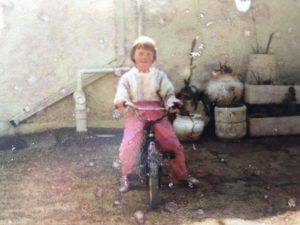
When we weren’t driving illegally, we were riding our bikes. My sister’s was a pink BMX, a gift from Father Christmas when we were just starting to figure him out (because honestly, how did he fit it in our small Jetmaster chimney?). It had tassels and a white seat. The white handles were moulded perfectly for the rider’s hands, ribbed with soft rubber, and I was so happy that she’d received it because it meant the blue one would become mine.

Blue had long padded pieces of waterproof canvas wrapped around the front handlebar and the frame with Velcro – which could be taken off and washed when it was time to play car wash – but were mostly as dirty as the roads they were ridden on. It had quite thick tires, and dad taught us how to oil our chains so that when we took them to the workshop for a service we could be mechanics without needing any assistance. 

We went everywhere on our bikes, fashioned a way to hold one of mom’s baskets on the front so that we could pack picnics for when we went fishing at the dam like Tom Sawyer. Although, I’m not sure Tom Sawyer and Huck Finn used biltong hooks at the end of a line of string tied to their fishing poles. It was no wonder we never caught any fish, and the reason we needed to pack food from home. 

Later, when we had grown out of our pinks and blues, the bikes were passed down to the next sibling, and my older sister used the black one (technically mom’s) which was the only one with gears. This made cycling up the hill before the turn in to our driveway slightly easier, and the rider of this bike was usually the one in charge of the games – because the black bike was always ridden by the eldest. 

We knew the dirt roads on our farm and around our house without being conscious of it – a map etched into our beings. The rough parts, like corrugated iron, where you lifted your feet up and bounced – sometimes singing so that you could hear your voice wobble. The very sandy sections where you dared not get caught going too slowly or you’d get stuck. The smooth sections with only light gravel that burned your bare feet in the Summer or made the worst grazes on your skin that mom would patch up with monkey blood – that’s what we called the red mercurochrome – if you fell there. And the man-made speed bumps, created with a grader to divert rain water off the road, which were ramped over – standing up and bending our legs as we flew with ease.

Fearless, we held competitions to see who could go down the hill the fastest and end up the furthest without pedalling. The corner at the bottom of the hill which lead to the workshop and old house was an added challenge to our made-up Olympic sport.

“ok, this time we stick our feet out”, we panted as we pushed our bikes back up the hill to start again. 

And down we would go, helmetless, barefoot. Feet out to avoid the pedals cutting into our shins. 

Screaming with joy.

The adjustable seats of all the bikes saw much use over the years. We learnt tricks without realising they were tricks – an old favourite was to make a dust wave when you slammed on breaks and let the back wheel slide out to the side. And when the training wheels were on because baby sister was learning how to ride a bike they made a really fun mud fountain – something we discovered by parking the bike over a big puddle outside the ram shed with the back wheel suspended in the water. Holding the breaks down we pedalled as fast as we could and sent the mud flying up behind us. We each took turns and the spectator was responsible for lending additional support to the front of the bike to prevent it from moving.

It was our favourite puddle, and the ram shed had a ramp which was perfect for driving down and right through the middle of it to create a tidal wave. This puddle of mud was endlessly fun, until we arrived at home one day covered in it from head to toe and mom, angry, made us hand wash our clothes which had been bought for us that very day.

“They were supposed to be town clothes!” said mom. 

Mine was a white T-shirt with navy anchors on, with a pair of matching navy shorts. 

Beautiful. 

…And full of mud. 

We giggled while we washed our clothes in the bath, badly, with a giant green bar of sunlight soap, our punishment for running out of the house before changing.

“Let’s go back tomorrow” my sister whispered.
The Girl Who Longed to Fly

The room was crowded.  Packed full of beds and wardrobes.  Wooden wardrobes that smelled damp and musty.  Like when you’re at the beach. Except now there are no warm or happy feelings.  This kind of damp was nauseating.  It smelled like years of neglect and sadness.  It smelled like brown. 

Brown was the colour of being seven years old.  Sometimes being seven was light blue, like on my birthday when my mom and granny came to visit me and gave me a “My First Recipe Book” and it was raining and I was so excited.  But then I remembered where I was, and being seven turned brown again. 

We stayed in that room, all six of us crammed in during the week.  My mom made me a bright bed cover that smelled like home for a while, but after a time it faded.  This room, that had bars on the windows to keep intruders out, felt like a prison with an unlocked door.  This room, where everyone seemed happy but me, where nothing flourished but the fat pigeons that mated on the roof and soiled the windowsills. 

“Go away, fat pigeon! You are not my turtle dove from home, or my piet-my-vrou, or my bulbul.  You mock me from your perch.  You can leave – but you don’t”.

Play time was controlled by a hand bell and strict rules.  “Where are your shoes?”, the hoarse voice of a life-long smoker growls from behind me. 

“I don’t need shoes! I don’t want to wear shoes! My mom doesn’t force me to wear shoes!” I say with a sudden surge of courage. 

I wait for the consequence.  I watch the eyes behind the thick smoky glasses.  They are devoid of emotion. 

I wait.

Nothing happens. 

The silence is worse.

My heart beats faster, the acid rises in my stomach.

The yellow nicotine mouth opens with a sneer to reveal the brown teeth and it laughs, “cut your feet then, your mother obviously doesn’t care if you do, so neither do I”.

I run away, over the tar and into the garden that is made of sand.  Nothing has survived because children ruin gardens… or so they say.  Beneath the tree the sand is not as hot but the spiked round balls that have fallen out of the beefwood tree now pierce into the thick skin under my feet.  Stupid tree, I hate this tree.  It is tall and sharp.  It hurts me.  But I cannot show it, so I brush them off and walk to my friends. 

We’re playing with a skipping rope where you jump three times and duck for one.  I love this game.  “One, two, three, eh-le-le, one, two, three, eh-le-le” we chant as we jump, forming a long line of sandy children waiting to run in during eh-le-le two at a time.  We get covered in the brown sand as the rope beats the ground, we’re dirty and our faces are flushed red.  We are happy.  My friend’s pony tail flies as she jumps and we laugh.  We forget for a moment.  Until the hand bell rings and we have to go inside for supper even though the sun is still shining. 

While waiting in line outside the dining room, I lean against the wall and feel the cool, solid comfort of the light green plaster against my warm, sandy skin.  It makes us pray – but instead of thanking God for the food we are about to receive, I’m asking him to make me a grown up, and I wonder whether I will go to hell… Or if perhaps I’m already there.  Amen.

I am about to walk in and I feel a bony hand grip my shoulder and pull me back.  The course voice rasps ‘You don’t have shoes on’.  This time I have to concede because I need my food so I run to fetch my shoes.  When I get back I am forced to wait until the end after the other children all have their places.  I am being punished because I ran indoors.  Rule number one is: NO RUNNING INDOORS.  I finally get my seat in between two others.  The middle seat is the worst because it is difficult to cut your food. And my arms are long.  And my tummy is round.  I don’t really fit here, but I’m not allowed to not fit, so I say nothing.    

I gulp my strawberry Nesquik that my mom bought for me and I quickly make another one before anyone notices how much milk I’m using.  I put in three heaped teaspoons and the milk turns pink and smells like marshmallows.  For a second I am transported back home where I can run without shoes on and feel the soft grass beneath my feet.  It is moist and green and smells like life.  When I fall it is painless and soft.  I can lie down and dream until I’m finished.  I don’t have to wait in a line for my food, I can get it at the same time as everyone else.  The smell is home. 

A loud clatter of metal pots brings my thoughts back to the dining room and I wipe the tear off my cheek and count how many more hours until I can get out.  Four sleeps.  89 hours.

After supper we have to bath.  Two people per bath to save water.  My soap is called Breeze and it is orange.  It stays in a pink soap box with my pink face cloth.  After I’m finished bathing I pack my toiletry bag into my locker next to my bed and I put my underwear in my laundry bag and my socks in the sock bin and I put on my pink nightie and gown and brush my hair.  Just like my mom taught me. 

We are allowed to watch TV for half an hour but I rather want to read my book and the others want to stay in the dorm and chat.  We all get into our beds, some reading, some chatting, some laughing and joking. 

I am halfway through a page in my favourite book series “Sweet Valley Kids” and the light is switched off.  The voice reminds us that we may not speak after lights out and I feel for my locker in the dark so that I can put my book and my thick, brown glasses away.

As I lie in the stuffy, full room that smells of brown wardrobe and soap, with my black school shoes tucked neatly underneath my bed, I feel the darkness envelop me.  It clutches at my stomach and my throat and I turn my face into my pillow.

‘Good night mommy, I miss you’ I whisper, my face wet with tears, before succumbing to a deep, sad sleep. 

How to “Share” a Sheep

It is October.

The sheep are brought in, the shearers are brought in, the extra labourers come, grandpa comes, mom works out of the house all day, we check in every now and then, dad is there.  In October.

My sister and I have to share a birthday party because she can’t have hers in October.  Why, mom? “Because we sharing”.

The sheep are in our blood.  We kill them, we eat them, we wear them, we lamb with them, we adopt them, we shear them, we laugh at the ram’s big testes, we dose them, we crutch them, we love them we hate them.

We watch the wool price with bated breath.  Is it high, is it low? Its high.  Phew, we breathe a sigh of relief.

The wool is taken off the sheep in early Spring, and sometimes the sheep’s skin is nicked.  The purple spray is used to protect the wound from infection and flies so there are lots of purple spotted sheep running around in the cold air making a noise. Shut up, sheep! Why, mom?  “Because we sharing”.

Children running around the shearing shed, a hustle and bustle of loud noises, shouting and sheep, clippers and machines.  The wool is taken off the sheep and graded.  My mom is the expert because she took a course on wool grading.  She can’t teach me now because she’s busy and she has to keep up with the shearers.  The other ladies help her.  This is woman’s work because it is light and you need your hands and your brain.  I want to be a wool grader when I’m old like my mom.  “Go and find your sisters”, she says.  “Don’t go near the press”.

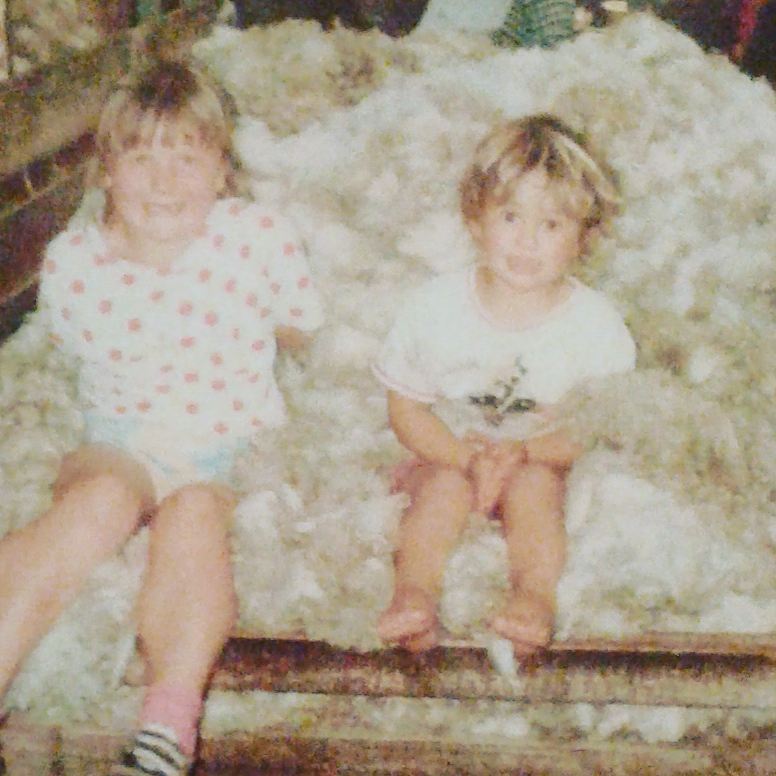
The wool press, like the engine room, was OUT OF BOUNDS.  We learned what OUT OF BOUNDS meant at boarding school.  Mom said it was because she didn’t want us to be pressed into a bail of wool and sold.  Haha, we laughed at her.  Silly mom.  We jump into the wool bin instead.  Bounce bounce and scratch scratch.  The wool is oily and soft and dirty and rough.  Baby sister and I playing in the wool pretending its water and we’re sailing away.  Mom picks her up and carries her to the tea station.  I follow.  I want tea.  I love tea.

We drink a steaming cup of too-strong tea and try not to burn our fingers on the metal cup and swing our feet under the chair.  Thobeka is there, she’s our other mom, she’s telling us in our other language that we must go home with her.

The long walk home starts as we navigate through sheep and pooh and shed cats.  Baby sister tries to get Thobeka to carry her and she says no, you must walk.  We run ahead and scream and shout because we love to run.  The blossoms are on the trees, and the grass is getting greener.  There’s a purple sheep giving me a quizzical look through the fence.  Isn’t it funny?

After October comes November.  That is my birthday and if it is warm enough we might be able to start swimming soon.

Up the Magic Oak Tree

When we were children, my sisters and I used to climb the old oak tree in the back garden behind the swing.

Up the old wooden ladder that wobbled at the fourth step and onto the first branch.  With our mis-matched clothes and holey corduroys with pockets full of apples, we scampered up effortlessly to occupy our spaces.  Me on the first branch with a slightly higher branch forming a back rest; sisters on the higher branches, one semi-circular to perfectly house the butt, and one higher up (only experienced climbers were allowed) which branched into a Y-shape and made a very comfortable day bed.  Baby sister had to sit at the top of the ladder and hang on to the tree for balance, waiting patiently to be deemed old enough to traverse higher into the branches of our game.   The person on the ladder was responsible for the basket  and the pulley – she had to refill the basket with Oros and apples for four.

From our occupancies we planned and schemed and dreamed and played.  We held each other in complete confidence for the conversations which occurred in the dappled sun of the tree’s shade.  As the bark roughly rubbed our smooth skin it was a sharp reminder of the years that went before us and the tree that had stood and watched it all.  What secrets it must have heard!  From high up we watched the life below us.   The hustle of people and animals coming and going, walking along the pathway leading to the kitchen door.  Grandpa coming for tea and mom emptying her flower vase onto the lawn.  The cats all running to the flower water to see if it is their food.  It is not.

Haha, they don’t know we’re here.

“Hey Grampa! Did you know we were here?” sister shouts.  He pretends to get a fright and gives us the chuckle we were waiting for.  He shoos the cats off his boots and goes into the house.  “Hello, love” we hear him say to mom as he takes off his hat.

We settle into our tree beds as the bustle below stills to a halt.

We get bored and decide to collect acorns.

It is nearing dusk, Grandpa left a few hours ago, we have a mountain of acorns and the mosquitoes are eating my ankles.  I want to go inside, I need to wee and I’m hungry.

“Let’s store the acorns and tomorrow we’ll sell them” sister says.  Excellent plan, we all agree.  We lower the basket with the empty Oros bottles and the acorns.  Baby sister jumps from her spot, I jump from mine.  Sisters climb to the ladder and land with a thud to the ground.  Someone starts an argument and all hell breaks loose.

The alluring peace of the tree all but forgotten.